Validating a Hypothesis

Designing for "Zero-Failure" Certainty at 600 km/h
The Context of High-Stakes Design ~
The Apollyon ADX-1 is an autonomous strike platform that operates at jet speeds (Mach 0.5). In this environment, design is no longer about "user delight"; it is about Human Performance.
The Challenge ~
When a platform moves at 166 meters per second, the gap between seeing a data point and acting on it can be the difference between mission success and a multimillion-dollar failure.

the Problem Lens
Identifying the Failure Pattern
Traditional Ground Control Station (GCS) software often prioritizes Data Transparency over Cognitive Clarity.
While engineers need every telemetry point, an operator under stress faces two specific risks:
1.
Change Blindness:
In a static, dense UI, a critical system warning (like a GPS-link loss) is easily missed because it looks identical to non-critical data (like fuel flow).
2.
Monitoring Fatigue:
Constant exposure to 50+ variables during a 150km transit makes the operator less likely to react sharply during the 10-second terminal strike phase.
the Hypothesis
"At high speeds, more data ≠ better decisions."
I explored the hypothesis that a State-Based Information Hierarchy—a UI that physically morphs its layout based on the mission phase—could significantly reduce cognitive load and improve target confirmation rates
the Exploration
Transit vs. Strike
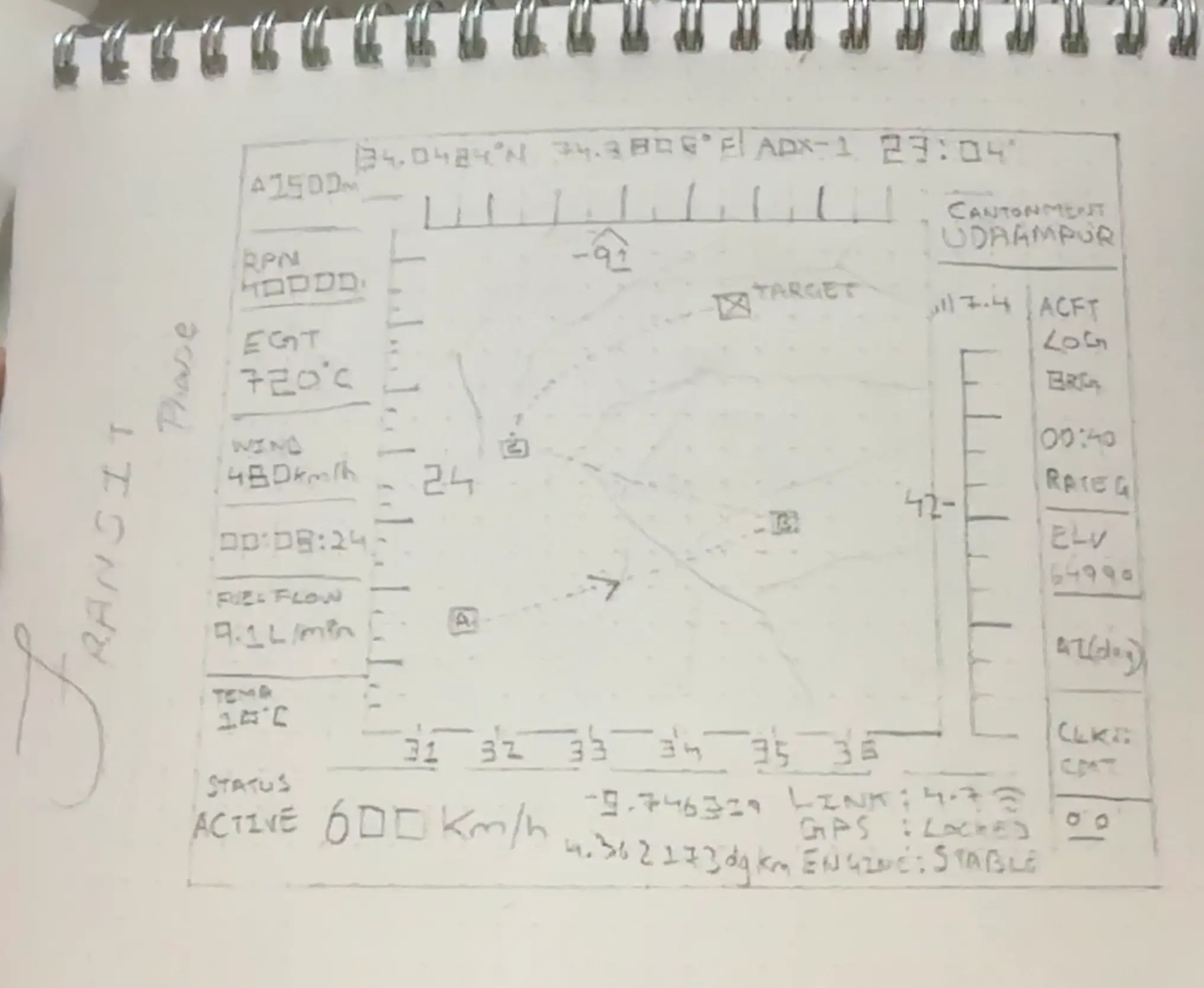

Manager
mode
phase A
The Transit State
During long-range navigation, the operator acts as a systems manager.
The Shift:
Navigation pathing, Signal Link health, and Turbojet vitals (Exhaust Gas Temp, Fuel Flow).
The Design Decision:
A comprehensive "expert view" that prioritizes hardware health to ensure the drone reaches the mission area.
Executioner
mode
phase B
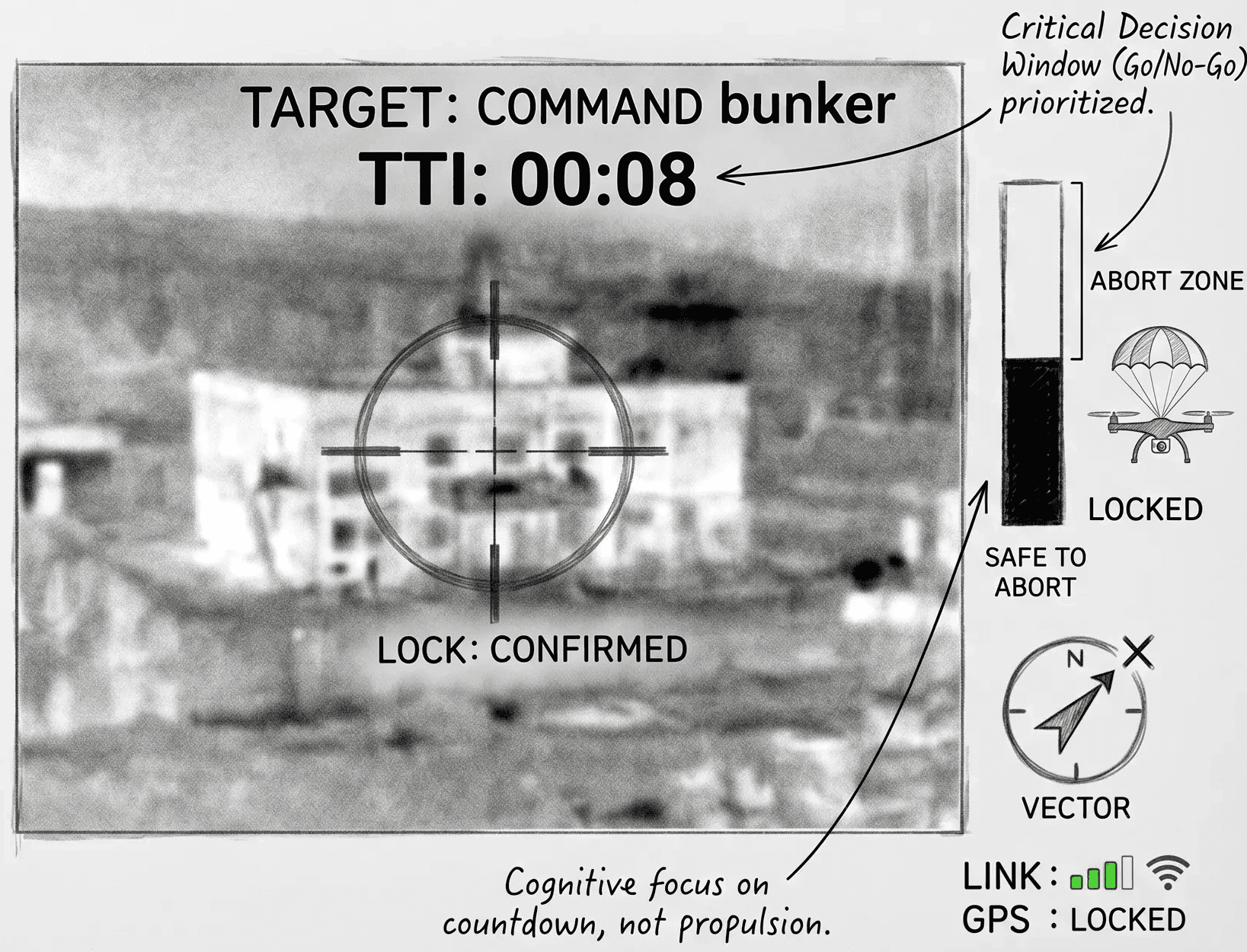
The Strike State
In the final 10 seconds of terminal engagement, the operator's role shifts to visual confirmation.
The Shift:
I suppressed all non-essential propulsion data. The turbojet temp doesn't matter if you're 5 seconds from impact.
The Design Decision:
The Seeker (Thermal) Feed expands to full screen. We introduce a massive TTI (Time to Impact) countdown and a "Point of No Return" Abort Bar to simplify the "Go/No-Go" decision.

Strategic
Impact & Validation
This wasn't just a UI exercise. It was a study in Human Factors.
By using my technical understanding of drone construction — BLDC systems, ESCs, and turbojet physics
— I was able to map real engineering constraints to user behavior.
What I’d Validate Next:
Latency Testing:
Developing predictive target overlays to compensate for the 150km signal lag.
Environmental Factors:
Testing high-contrast color palettes for readability in high-glare field conditions (e.g., desert or high-altitude operations).
Haptic Feedback:
Integrating physical controller resistance (HOTAS) as the drone approaches the "Point of No Return."

but, what did I learn…??
Design is a force multiplier.
For deep-tech startups like Apollyon, the interface is the final bridge between advanced hardware and successful mission outcomes.
✦ Industry Response
This exploration was shared publicly to invite discussion from people building in this space.
The founders and team at Apollyon Dynamics
Apollyon Dynamics
engaged with the work, acknowledging the analysis and contributing to the conversation.
While this does not validate the hypotheses, it signals that the problem space resonates with real-world builders operating under similar constraints.


The team at Apollyon engaged with the ideas, signaling alignment with real-world challenges.
// This work is based on publicly available information and is intended as a hypothesis-driven exploration, not a representation of internal systems.
